By Michael Mynn
Chief Advisor of FedMSB
If you’re leading payments at a bank, network, or fintech, 2025 probably didn’t feel like “another year of optimization.” It felt like the ground rules shifted mid-game.
Not because any single technology “won.” The pivot is more subtle—and more disruptive: cross-border payments stopped evolving on one modernization track and started converging across several at once. Standards and data (ISO 20022), transparency (SWIFT gpi), new distribution surfaces (wallet interoperability), new settlement experiments (stablecoins and tokenisation), and a new initiation model (agentic AI) all moved forward in the same calendar year.
That convergence turns cross-border from “a network” into a composable stack—and it changes what leadership looks like. The differentiator is no longer access to a rail. It’s control of orchestration, data quality, risk, and finality.
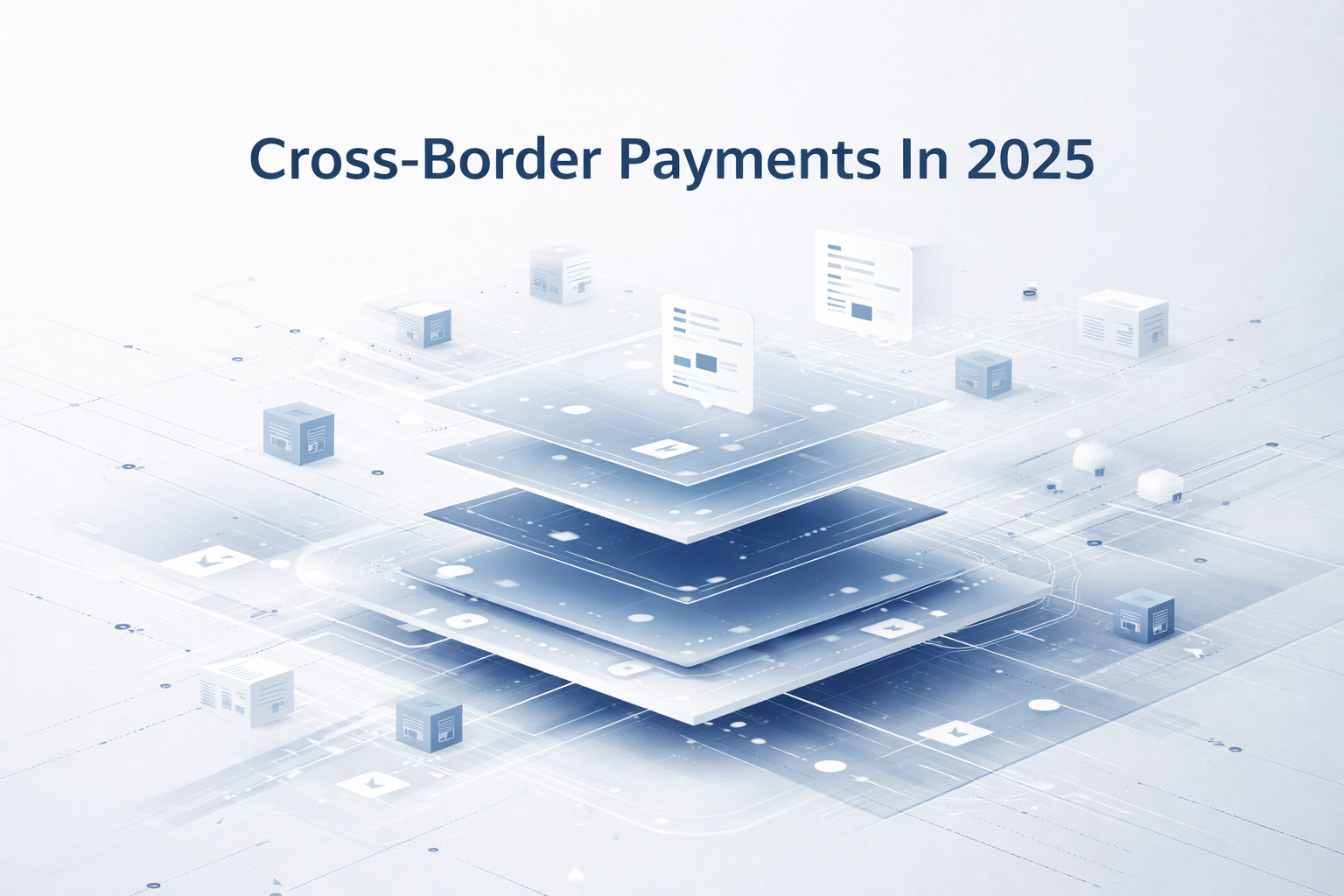
The new reality: Cross-border is now a stack, not a pipe
The old mental model is linear: send → correspondents → FX → settle → notify. The 2025 model looks more like cloud infrastructure:
- A data plane (message quality, structured fields, identity artifacts)
- A routing plane (which rail(s) you choose per transaction, with retries/fallbacks)
- A risk plane (KYC/AML/sanctions + fraud + disputes)
- A settlement plane (nostro/vostro, prefunding, local clearing, blockchain settlement options)
- A distribution plane (wallets, platforms, embedded finance, agentic checkout)
Once you see it this way, the strategic question changes from “Which network?” to “Which layer do we own—and which layers do we rent?”
ISO 20022 is the “boring” pivot that forces everything else to get real
The cleanest marker that 2025 is not incremental: the ISO 20022 transition hit its hard milestone. SWIFT reconfirmed 22 November 2025 as the end of the CBPR+ coexistence period for cross-border FI-to-FI payment instructions—pushing the industry from MT comfort into MX reality.
This is not a formatting exercise. Structured data changes unit economics:
- Fewer repair fees and investigations
- Better straight-through processing
- Better compliance screening with fewer “false breaks”
- Cleaner reconciliation and reporting
For fintech builders, this is a product unlock: data enrichment, validation, and exception prevention become competitive features, not back-office chores. For banks, it’s a mandate: you can’t “opt out” of message quality and still expect to compete on experience.
SWIFT gpi: transparency isn’t a nice-to-have, it’s working capital
SWIFT gpi’s value proposition—real-time end-to-end tracking and better fee visibility—sounds like UX polish until you view it through the CFO lens: it’s a liquidity management tool. When corporates can see where a payment is stuck, they don’t just feel better; they fund differently.
The strategic implication: visibility is becoming part of the product contract. If you can’t provide status, ETA, and fee transparency at scale, you’re not merely “older.” You’re less usable.
The G20/FSB roadmap reality check: the industry is modernizing, but outcomes aren’t keeping pace
Here’s the uncomfortable truth that makes 2025 feel like a pivot rather than a victory lap: the public sector’s flagship effort to improve cross-border payments is warning about execution risk.
In its 2025 consolidated progress report, the FSB calls for stronger implementation to achieve tangible improvements against the roadmap goals (faster, cheaper, more transparent, more accessible). And Reuters reported that the push is set to miss the 2027 target, with only modest improvements showing up in measured outcomes so far.
Translation for execs: we are building the future, but we’re not delivering it evenly. That gap is where disruption lives—because when institutions can’t deliver the targets, new settlement methods and new networks become politically—and commercially—tempting.
Stablecoins: legitimacy rose faster than volume
Stablecoins were the headline-grabber in 2025, but not because they took over cross-border flows. It’s because regulation began turning them from “experiments” into boardroom-permitted infrastructure.
You can see the policy scaffolding in the GENIUS Act text defining “permitted payment stablecoin issuers,” including pathways for insured institutions and approved nonbanks. And in December 2025, the FDIC approved a proposal to implement GENIUS Act application provisions—an implementation signal that matters more than any single pilot press release.
But 2025 also surfaced the central tension: stablecoins are simultaneously an efficiency story and a systemic-risk story. Reuters reported the BIS warning that stablecoins can pose risks (monetary sovereignty, transparency, instability), while advocating a more integrated tokenised financial system as an alternative direction.
So the “pivot” isn’t “stablecoins win.” It’s that stablecoins became a credible option in the settlement plane—and regulators started drawing the lines for who can touch them and how.
Tokenisation: the bank-friendly path that could quietly matter more
If stablecoins are the visible wave, tokenisation is the undercurrent. The BIS annual report argues tokenisation could replace the complex chain of intermediaries and sequential account updates in correspondent banking with a single integrated process.
And the BIS Innovation Hub’s Project Agorá (updated Oct 2025) explicitly frames tokenisation as a cross-border exploration that will publish lessons learned in the first half of 2026.
For payments execs, tokenisation is the “institutional compromise” narrative: keep regulated money at the center, but modernize the mechanics. For fintech builders, it’s a warning and an opportunity: if banks get a credible tokenised settlement lane, the value shifts to connectivity, compliance abstraction, and workflow integration, not “we’re faster than banks.”
Wallet interoperability: distribution is becoming network-to-network
2025 also weakened a long-running assumption: wallets are domestic; cross-border belongs to banks and cards.
PayPal announced PayPal World as an interoperability platform connecting major wallets and payment systems, with launch partners including Mercado Pago, NPCI International Payments Limited (UPI), Tenpay Global, Venmo, and PayPal—positioned to roll out late 2025.
TerraPay launched Xend (Nov 24, 2025) as a wallet/bank/card interoperability network, and Mastercard announced a collaboration in December 2025 to expand digital wallet acceptance via TerraPay’s platform.
The deeper point: interoperability shifts competition from “corridor coverage” to ecosystem access. If users keep value in wallets, the winning cross-border players are the ones who can make those wallets function internationally with minimal friction—without forcing a new app, new KYC, or new habits.
Agentic AI: payments are moving from “automation” to “initiation”
Most AI talk in payments used to be operational—fraud models, customer support, internal productivity. 2025 made a more strategic leap: AI agents as initiators of commerce.
Visa’s “Trusted Agent Protocol” and its broader push for agent-enabled commerce are explicit attempts to create a framework where merchants can verify agents and distinguish them from malicious bots. Visa also positions “Intelligent Commerce” as tooling and safeguards for agents to transact through Visa rails.
Here’s why that’s a pivot: once agents initiate payments, your core risk questions change:
- What is “customer consent” in machine terms?
- How do limits, approvals, and dispute rights work when actions are delegated?
- How do you separate legitimate agents from scaled fraud?
If you’re building fintech infrastructure, the opportunity is enormous—and so is the compliance surface. Agentic payments will reward providers with strong policy engines, identity proofs, audit trails, and real-time risk controls.
The market is expanding—and fragmentation is part of the growth story
Multiple industry sources are now repeating a scale claim: global cross-border payments are expected to reach roughly $290 trillion by 2030 (often cited in FI thought leadership).
Meanwhile, in remittances specifically, the World Bank estimate often cited across the industry is about $905 billion in 2024 (up from ~$865B in 2023), reinforcing that consumer flows remain massive—and still fee-sensitive. Costs also remain stubbornly high in many corridors; the World Bank’s Remittance Prices Worldwide continues to show global averages well above the SDG target.
Growth + fragmentation is the key executive takeaway. Volume expands even as the rails diversify—which makes orchestration and governance more valuable than ever.
What to do with this as an executive or builder: win a layer, don’t “do everything”
The biggest mistake in pivot years is trying to chase every trend equally. The better play is to decide which layer you’re going to dominate:
1) Own the orchestration layer
Be the system that decides the route (real-time rail vs local clearing vs SWIFT vs wallet-to-wallet vs blockchain settlement), retries intelligently, and provides the analytics to prove it worked.
2) Own the data + compliance layer
ISO 20022 gives you the substrate. Build the enrichment, validation, screening, and exception prevention that makes cross-border actually scale.
3) Own the settlement innovation layer
If you’re going after stablecoin/tokenised settlement, treat it like regulated infrastructure, not a feature: governance, controls, auditability, liquidity strategy, and counterparty risk are the product.
4) Own the distribution layer
Interoperability is distribution. If you can plug into wallet networks and platforms, you can acquire flows without owning every corridor end-to-end.
The 2026 question that 2025 created
2025’s pivot isn’t that the old world died. It’s that it stopped being the only world. The defining 2026 question will be: which of these parallel tracks becomes “normal”—and who gets relegated to being a commodity processor inside someone else’s stack?
That’s the real shift from incremental progress to pivot-year dynamics: once the stack is modular, value migrates to the layer with the most leverage.